OCTOBER 2026 / WIND ORCHESTRA SPECIAL / CONCERT REPORT
Professional Sound, Teenage Hearts.
Nervous freshmen, seven pieces, unexpected laughter — and a performance that revealed the extraordinary musicianship of Ohyun High School's young players.
2026 Annual Concert · Ohyun High School Wind Orchestra
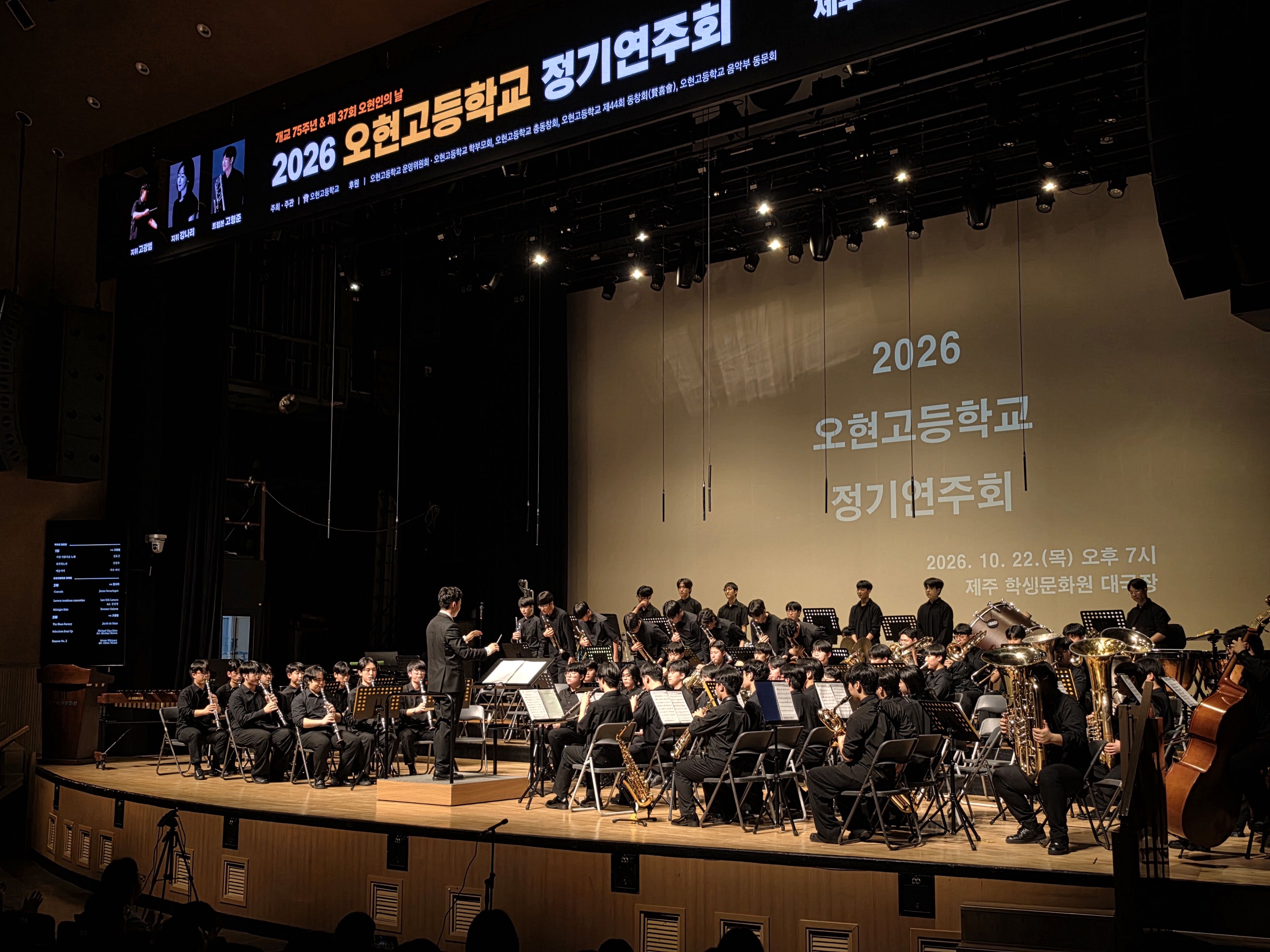
The Ohyun High School Wind Orchestra performs on stage at Jeju Student Cultural Center during its 2026 Annual Concert.
Before the first note was played, the backstage waiting room was filled with something the audience could not hear: nerves.
Four first-year members — Yumin Oh and Seung-hyeon Kang on tuba, Gyu-ho Hyeon on saxophone, and Min-jun Kang on flute — could barely stay still as they waited to perform. At the Jeju International Wind Ensemble Festival, they had played two pieces. This time, the concert program held six main orchestra pieces, plus an encore. Some of the music was especially demanding. Knowing that their fellow students and teachers would be watching only made the anticipation more intense.
Yet once the performance began, the nervous teenagers sounded remarkably assured. It was the first of several contrasts that made the evening memorable: youthful uncertainty offstage, and impressive musical control onstage.
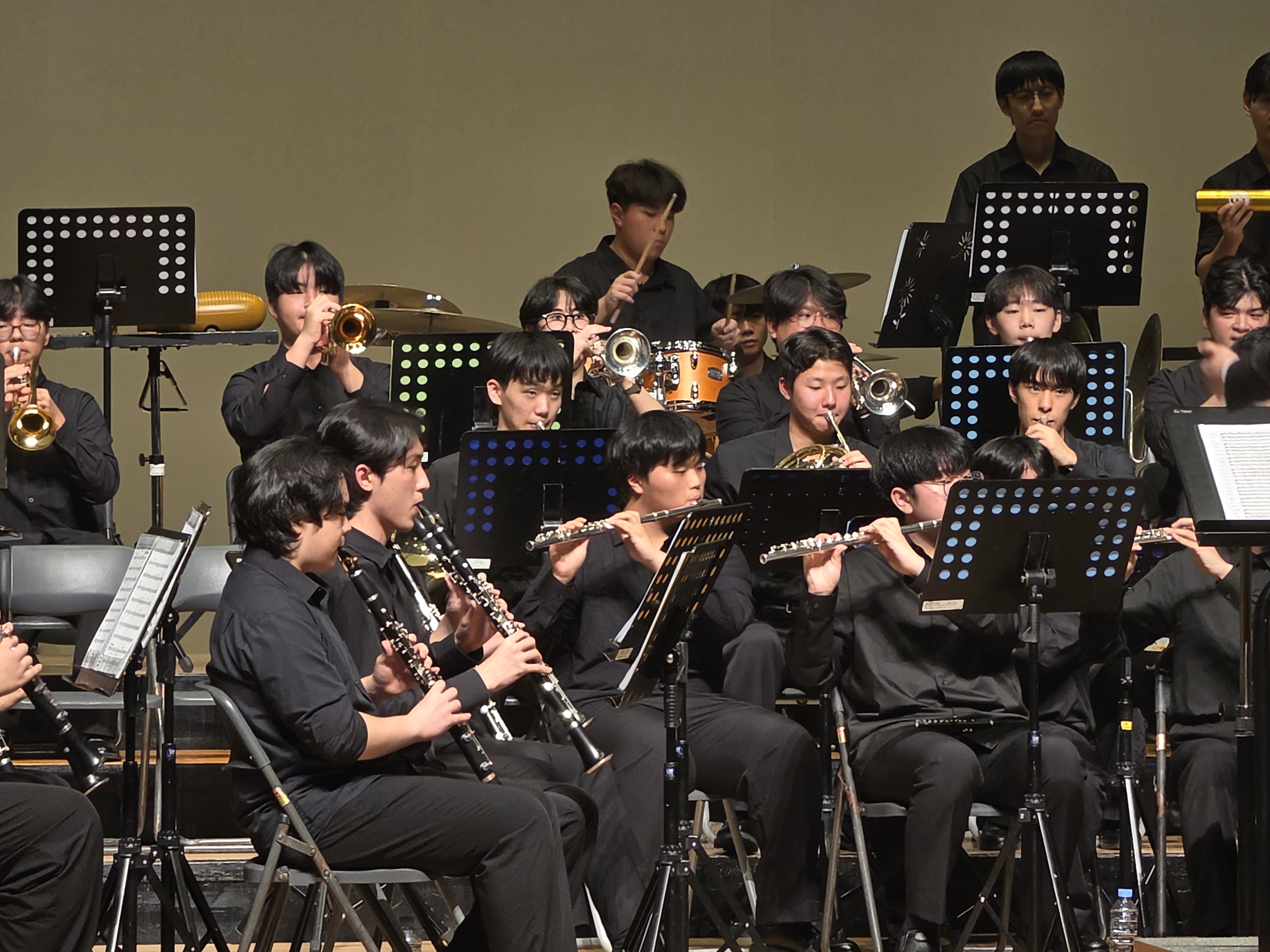
Wind orchestra members perform with deep focus and precision during the concert.
01 / THE MUSIC
Not the Orchestra You Might Expect
For many listeners, the word orchestra brings to mind Beethoven, Bach, and familiar classical masterpieces. But this concert offered a much broader musical landscape. The wind orchestra moved between traditional concert-band works, a trombone feature, blues-inspired rhythms, music from the animated film Up, and the dance-driven intensity of Danzon No. 2.
Part II, conducted by Nari Kang (Teacher Nari), featured Centuria, Trombone Concertino, and Midnight Ride. Part III, conducted by Gwangbeom Ko (Teacher Gwangbeom), followed with The Blues Factory, Selections from Up, and Danzon No. 2. The orchestra then returned for an encore, Midnight Serenade.
The variety in the program was deliberate. Teacher Gwangbeom explained that the repertoire had been set before the school year began with two main goals: to give students a well-rounded music education across diverse genres—featuring traditional wind band classics in the first half, followed by jazz, swing, and Latin rhythms like Danzón in the second—and to keep the performance engaging and memorable for the audience.
Selections from Up — Michael Giacchino (arr. Michael Brown)
Danzon No. 2 — Arturo Márquez (arr. Oliver Nickel)
Encore
Midnight Serenade
🎥 Performance Highlight: Watch the Ohyun High School Wind Orchestra perform Arturo Márquez's Danzon No. 2.
One piece in particular stood out: Danzon No. 2. As its rhythms gathered momentum and the ensemble surged toward its most dramatic passages, the level of musicianship was striking. Individual solo lines emerged with confidence, then rejoined the full orchestra. For a listener who had arrived expecting a school concert, it was a moment of genuine surprise at what these students could achieve.
AUDIENCE REACTIONS
Through the Audience’s Eyes
The orchestra’s performance also surprised students in the audience.
First-year student Junhyeon Kim, attending an Ohyun wind orchestra concert for the first time, said the performance impressed him even compared with professional orchestras he had seen before. He was especially amazed that students he knew could create music of such quality. His favorite piece was Centuria, which best suited his musical taste.
For second-year student Taeyoung Kim, the concert offered something equally valuable: a chance to experience a high-quality orchestral performance at school, an opportunity he rarely has.
Their reactions showed that the concert was more than a showcase of the orchestra’s achievements. It was also a memorable cultural experience for the wider school community.
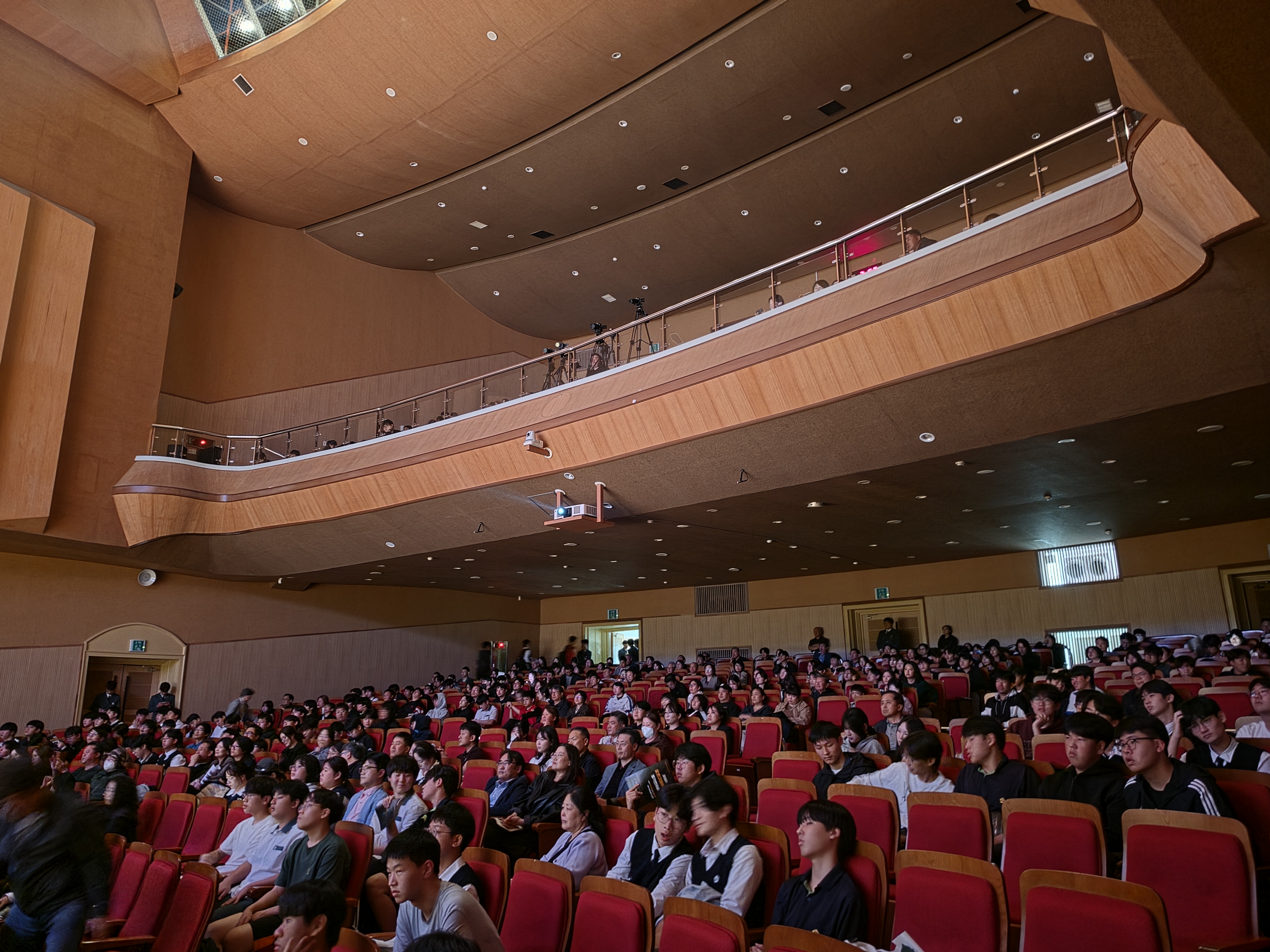
Students, faculty, and family members filled the concert hall to support the young musicians.
02 / THE PREPARATION
Months of Work Behind One Evening
How could students learn so many new pieces in a single school year? According to Teacher Gwangbeom, the preparation was planned from the start. Beginning in March, scores were distributed gradually according to each piece's difficulty. Students practiced for around 30 minutes during lunch breaks each school day, with additional preparation during regular club activity periods — all while trying to keep rehearsals from interfering with their academic work.
Those short daily rehearsals added up. What the audience experienced as a seamless evening of music had been built through months of preparation — new scores, unfamiliar rhythms, demanding passages, and the steady commitment of students balancing music with schoolwork.
One evening onstage. Months of music behind it.
From the first rehearsal to the final performance, the musicians learned to meet the demands of an ambitious program together. By concert night, their preparation was reflected in the confidence and energy of the ensemble.
03 / THE HUMAN SIDE
Still Teenagers, After All
For all the musical precision, the evening also offered a moment of unmistakable teenage charm.
At the end of Part II, Teacher Nari signaled for the orchestra to stand and take a bow. Then she walked offstage — without telling them to sit back down. The entire orchestra was left standing, looking left and right at one another, as if silently asking, “Are we supposed to sit now?” After ten awkward seconds, a visiting music instructor finally gave them the signal to sit, bringing the moment of confusion to a hilarious end.
It was a delightful reminder that the same musicians who had just delivered such a disciplined performance were, after all, high school students — still capable of being flustered by something as simple as when to sit down.
04 / THE FINAL NOTE
More Than a School Concert
From the anxious first-year musicians backstage to the confident solos and sweeping rhythms of Danzon No. 2, the concert revealed two sides of the Ohyun High School Wind Orchestra. One was its musical ambition: a repertoire chosen to challenge young performers and delight a varied audience. The other was its humanity: students who laugh, worry, hesitate, help one another, and return to rehearsal the next day.
What the audience heard in one evening was the result of months of lunchtime practice — and of dozens of young musicians learning how to turn their individual efforts into one remarkable sound.