Last month, before it got this hot, I used to come home late every day because I was in the middle of my final exam preparation period. Moreover, since my academy was far from my house, I had to get a ride home in my mother’s private car. There was a scene I saw every single day on my way home: cars parked along the roadsides and a fully packed underground parking lot with absolutely no vacant spaces. Because there was no place to park, my mother had to park the car outside and walk back home with me. As a result, she felt highly inconvenienced by the lack of parking spaces. In this situation, one might ask, "Why don't we just build more parking lots?" But would that really be okay? Wouldn't there be any issues?
1. Geological and Structural Limitations
However, there are several major obstacles to this. Since Jeju Island consists of highly porous basalt rock formations and lava tubes, its ground structure is extremely weak and vulnerable. Furthermore, thick layers of sand have been discovered in local ground conditions. Due to these weak ground conditions, expanding parking structures here is highly risky; building additional parking towers or underground parking lots is limited in terms of safety and economic feasibility.
In fact, despite these challenges, the number of parking spaces relative to the population is actually very high. According to Headline Jeju, citing the "2025 Jeju City Parking Lot Supply, Demand, and Safety Management Fact-Finding Survey," the overall parking space self-sufficiency rate is reported to be 124%. Therefore, simply building more parking lots just because of a perceived shortage is not a fundamental solution.
2. Exceptionally High Vehicle Ownership Rates
Secondly, the registered vehicle count per capita is exceptionally high. Below is the data obtained from the National Data Agency.
| Region | Vehicles Per Person |
|---|---|
| Jeju Special Self-Governing Province | 1.1 vehicles |
| National Average (South Korea) | 0.5 vehicles |
What we can infer from the data above is that Jeju's registered vehicle count per person (1.1) is more than twice as high as the national average (0.5 vehicles). Of course, this figure includes rental cars or vehicles that are registered in Jeju due to tax benefits but are actually operated outside the province. However, even when taking this into account, as we can practically feel, the high number of vehicles relative to the population clearly explains why we experience a lack of parking spaces due to the sheer volume of cars.
3. Avoidance of Paid Parking Lots
Thirdly, there is a strong avoidance of using paid parking lots. As mentioned above, despite the abundance of parking lots, another reason we still feel a shortage is this very tendency to avoid paid parking spaces. Naturally, one can understand this inclination. Why would anyone willingly pay to use a parking lot when they can just park right in front of their destination for free? This preference for spaces that are highly accessible or free, rather than paid parking lots that require a fee, inevitably leads to a shortage of available parking spaces.
Evaluating Administrative Policy: The "Garage Proof System"
Then, has the provincial government (the Jeju Executive Administration) been idle? That is not the case. A representative example of their efforts is the "Garage Proof System" (Vehicle Garage Verification System). The Garage Proof System is a policy that mandates car owners to secure a designated storage space for their vehicles. It is compulsory to prove ownership of a garage when purchasing a new car, changing one's address, or transferring vehicle ownership.
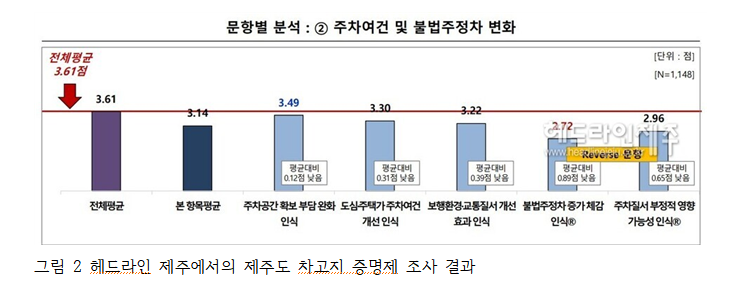
At first glance, it seems like an attractive solution to secure parking spaces by curbing car ownership. However, while residents who use their vehicles for their livelihood struggled to secure garages and faced heavy financial burdens, loopholes such as registering rental cars or registering vehicles in other regions to evade the system became rampant. The economic burden on residents intensified, as they had to lease separate parking spaces just to own a private car.
Due to these issues, the system was revised in 2025. However, even with these revisions, the fundamental problem could not be resolved. So far, we have examined the issues surrounding the parking space shortage and the limitations of their solutions. The challenges encountered likely forced Jeju to self-reflect. I hope that in the future, we will see a resolved state of this parking shortage, through measures such as providing incentives to vitalize the use of paid parking lots.
Reader Responses
What part of the student-led publishing process surprised you the most? Share your thoughts.