Why do these two nations—once allies, now bitter rivals—still struggle to trust each other after a century? While news screens today are filled with drones and missiles, the real "war" is being fought over memories of betrayal that date back long before the current headlines.
The Seeds of Betrayal
The roots of Iranian distrust weren't planted by modern politicians, but by the collapse of dynasties. In 1921, Reza Khan established the Pahlavi dynasty with dreams of a modern Iran. However, during World War II, those dreams were interrupted when Britain and the Soviet Union invaded to secure oil routes, forcing the Shah to abdicate. For ordinary Iranians, this was a painful lesson: your borders are only as secure as the Great Powers allow them to be.
1953: The Wound That Never Healed
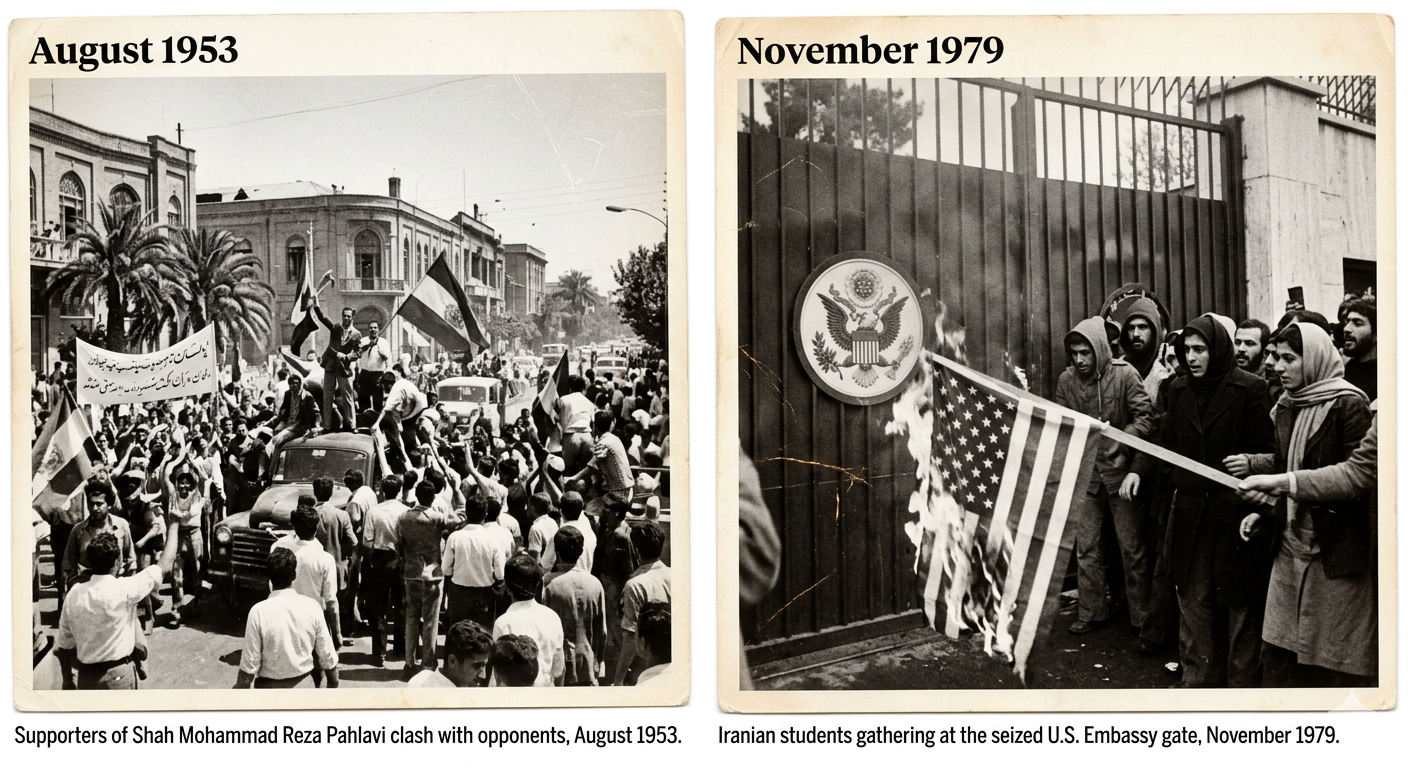
If you want to understand why Iranian protesters still shout slogans against "Western interference," you have to look at 1953. Prime Minister Mohammad Mossadegh, a man who represented the democratic hopes of many Iranians, dared to nationalize Iran’s oil. In response, the CIA and British intelligence orchestrated Operation Ajax to overthrow him.
By restoring Shah Mohammad Reza Pahlavi to power, the West prioritized oil over Iranian democracy. This moment fundamentally shifted the perception of the United States in the eyes of the Iranian people.
From Revolution to Deadlock
The explosion came in 1979. The Islamic Revolution wasn't just about religion; it was a violent rejection of decades of foreign-backed rule. When students seized the U.S. Embassy and held 52 Americans hostage for 444 days, the trauma flipped the script. For Americans, Iran became a "rogue state"; for Iranians, the U.S. remained the "Great Satan."
Even brief windows of hope—like the 2015 Nuclear Deal—have been slammed shut by shifting political winds in Washington. When the U.S. withdrew from the deal in 2017, it reinforced a narrative that Iran has told its people for decades: The West’s promises are written in sand.
Our Perspective: More Than Just Politics
Behind the military maneuvers are millions of ordinary people. While leaders in Washington and Tehran exchange threats, an entire generation of young Iranians—who are more connected to the world than ever—is caught between a government that uses history as a shield and a global community that views them only through the lens of conflict.
We must ask ourselves: Can diplomacy ever succeed when both sides are reading from two completely different history books? As long as the ghosts of 1953 and 1979 continue to haunt the negotiating table, the "War Behind the War" may never truly end.
Reader Responses
Do you believe history is the biggest obstacle to peace? Share your thoughts on global conflicts.