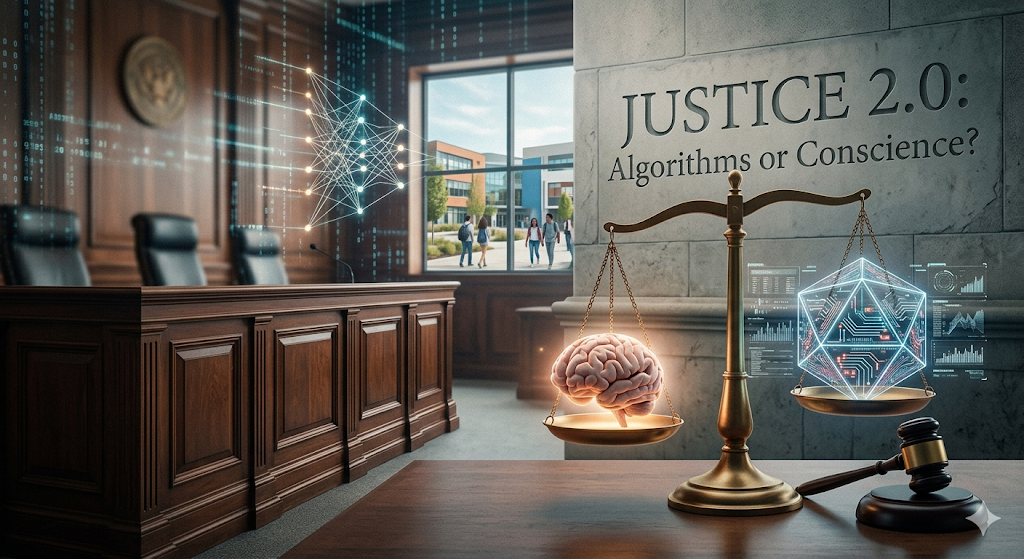
Every morning, AI recommends the music I listen to and even helps me draft my school reports. As a student living in this "automated" era, I started to wonder: If machines can decide what I like, can they also decide what is "right"? While many are excited about AI transforming the law, we need to ask ourselves a serious question: Will technology redefine justice, or will the human heart remain its core?
In today’s legal world, human thought is no longer the only player. Tools like Lex Machina can analyze thousands of past cases in seconds. For us students, who are used to "fast and easy" digital solutions, this sounds like a dream. No more tired judges, no more personal moods affecting a verdict—just pure, cold logic.
The danger is that AI isn't actually "new." It’s a mirror of our past. When I researched the COMPAS system used in U.S. courts, I was shocked. A study by ProPublica found that this AI was twice as likely to wrongly label Black defendants as high-risk compared to white defendants (Angwin et al., 2016). If we let code make the final call, we aren't creating a better future; we are just repeating old prejudices at a much faster speed.
This is why some are already fighting back. In 2019, France banned the use of AI to analyze judge's patterns (Loi n° 2019-222). This law serves as a powerful reminder: An algorithm can calculate data, but it cannot understand the weight of a human life.
Real justice requires "moral responsibility." A computer can follow logic, but it lacks a conscience. It cannot feel the heavy silence of a courtroom or understand the complex "mercy" behind a mistake. These are qualities found in the human spirit, not in a database.
As we—the next generation—prepare to lead an AI-driven world, we must not trade our moral duties for convenience. Technology should be a tool to assist, but the final heartbeat of a decision must be human. After all, justice shouldn't be a line of code; it must be a reflection of our shared conscience.
As we build the future, are we ready to keep the 'human' in justice, or are we willing to let the machines have the last word?
Reader Responses
Would you trust an AI judge? Share your perspective on the future of law.